
What to Do When 811 Marks Don’t Match Your Plans
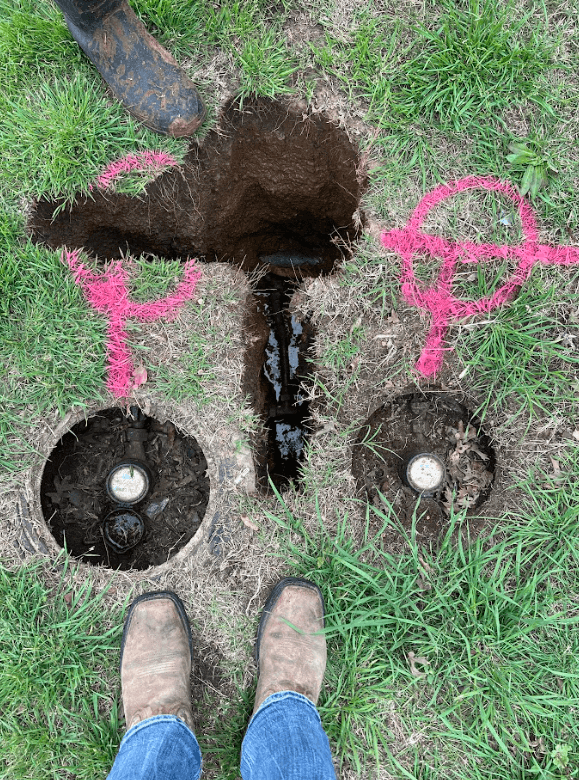
Paint says one thing. Plans say another.
You’ve got 811 marks on the ground, but the drawings show utilities running in completely different locations.
Or worse, the plans show lines that are not marked at all.
Now the trench crew is standing there trying to decide what is real before excavation starts.
That is exactly how utility strikes happen.
Someone assumes the paint is correct without verifying what is actually underground.
One bad trench bucket or drill path can stop the job immediately.
What Does This Cost?
Verification locating typically runs $995–$1,200 for a half day.
Larger or more congested projects generally start at $1,800+ for full-day work.
Small targeted verification work can often be handled at $200/hr with a 2-hour minimum.
Same-day or next-day scheduling is available in most cases.
Most jobs are completed in a single mobilization with field markings provided immediately onsite.
What Affects the Price?
Pricing depends on how much conflict exists between the plans and the field markings.
A few questionable crossings are one thing.
A congested site with overlapping utilities, abandoned lines, and incomplete records takes more time to verify safely.
Other factors include:
Utility density and congestion
Number of conflicting utility paths
Size of the verification area
Access limitations onsite
Active construction conditions
Tight corridors or restricted work areas
The more uncertainty onsite, the more important proper verification becomes before digging starts.
What You’re Actually Paying For
You are paying to resolve conflicts before excavation begins.
Verification locating helps determine whether existing marks are correct, incomplete, or missing utilities entirely.
That includes identifying unknown utilities, verifying utility alignment, and helping crews avoid digging into critical infrastructure.
One bad locate can shut the site down immediately.
Now excavation stops while crews wait, utilities get repaired, and project teams try to figure out what happened.
That delay costs more than the locate ever would.
It is also important to understand what 811 is and what it is not.
811 is a notification system for participating public utilities.
It often does not include private lines, interior utilities, owner-installed systems, or many site-specific conditions.
SiteTwin works where 811 is incomplete or where field verification is needed before trenching or drilling.
What Happens Onsite?
A technician uses EM locating and GPR scanning to re-evaluate the work area.
Utilities are located live and marked directly on the ground in real time.
Your crew gets immediate clarification onsite instead of guessing from conflicting information.
You may see existing 811 marks confirmed, corrected, or adjusted based on field findings.
Missing utilities, crossings, and conflict zones can also be identified and flagged before excavation starts.
Scanning and locating happen live onsite so crews can make decisions immediately and keep production moving.
Typical Scheduling
Same-day or next-day availability is common depending on workload.
Most jobs take between 2–6 hours onsite depending on utility congestion and project size.
Results are marked immediately onsite with no waiting for delayed reports before work can continue.
When You Need This
When 811 marks do not match the plans
When utilities appear to be missing
Before trenching, drilling, saw cutting, or excavation in high-risk areas
On private property where 811 coverage is limited
On remodel projects with unknown existing conditions
In congested utility corridors with multiple crossings
When the cost of a bad locate is higher than the cost of verification
Stop and Verify Before Excavation Starts
If the plans and paint do not agree, stop and verify before excavation starts.
That is where most utility strikes happen.
Send the address and scope and get it checked before the trench opens up.
Related Services
Utility Locating Services
GPR Scanning Services
If something onsite does not add up, do not gamble on incomplete information.
Get utilities verified, remarked, and cleared before your crew starts digging.
That is how you avoid shutdowns, rework, and crews standing around waiting on a preventable problem.
Schedule Verification Service
Send Address + Scope Here
For more excavation risk, utility locating, and underground infrastructure content, check out the The Damage Report Newsletter