
How Deep Are Utilities Buried in Texas?
Everyone wants a number, so here are the honest ones: typical installation depths, why the line under your site probably is not at them, and what to do when depth actually matters. The short version: depth is a habit, not a promise.
The ranges installers usually aim for
These are common installation practices for new work, useful for planning and useless as a guarantee. Actual requirements vary by utility, code edition, and location, and older installations answered to older rules or none at all.
Telecom and cable commonly go in shallowest, roughly a foot or so of cover. Gas distribution and electric secondary typically see on the order of one to two feet. Electric primary commonly runs deeper, in the two-to-four-foot range. Water mains get buried below typical service depths, and sewer runs wherever gravity demands, from shallow laterals to very deep mains.
- Telecom and cable: often the shallowest lines on a site
- Gas distribution: commonly one to two feet of cover
- Electric primary: commonly two to four feet
- Water: below service depths; sewer: grade-driven, can be deep
- Older installs: whatever the era's rules and the installer allowed
Every range above describes intent at installation, not the line under your site today.
Three Reasons the Real Depth Differs
Even a line installed perfectly to spec stops being at spec.
Grade Changed
Sites get cut, filled, and regraded. The line stayed put while the surface moved, so cover changed without anyone touching the pipe.
Soil Moves
Texas clay swells and shrinks seasonally, and decades of cycles walk lines away from installed depth and alignment.
Rock Decided
Where limestone sits shallow, installers buried lines as deep as the rock allowed, which is often far less than spec assumed.
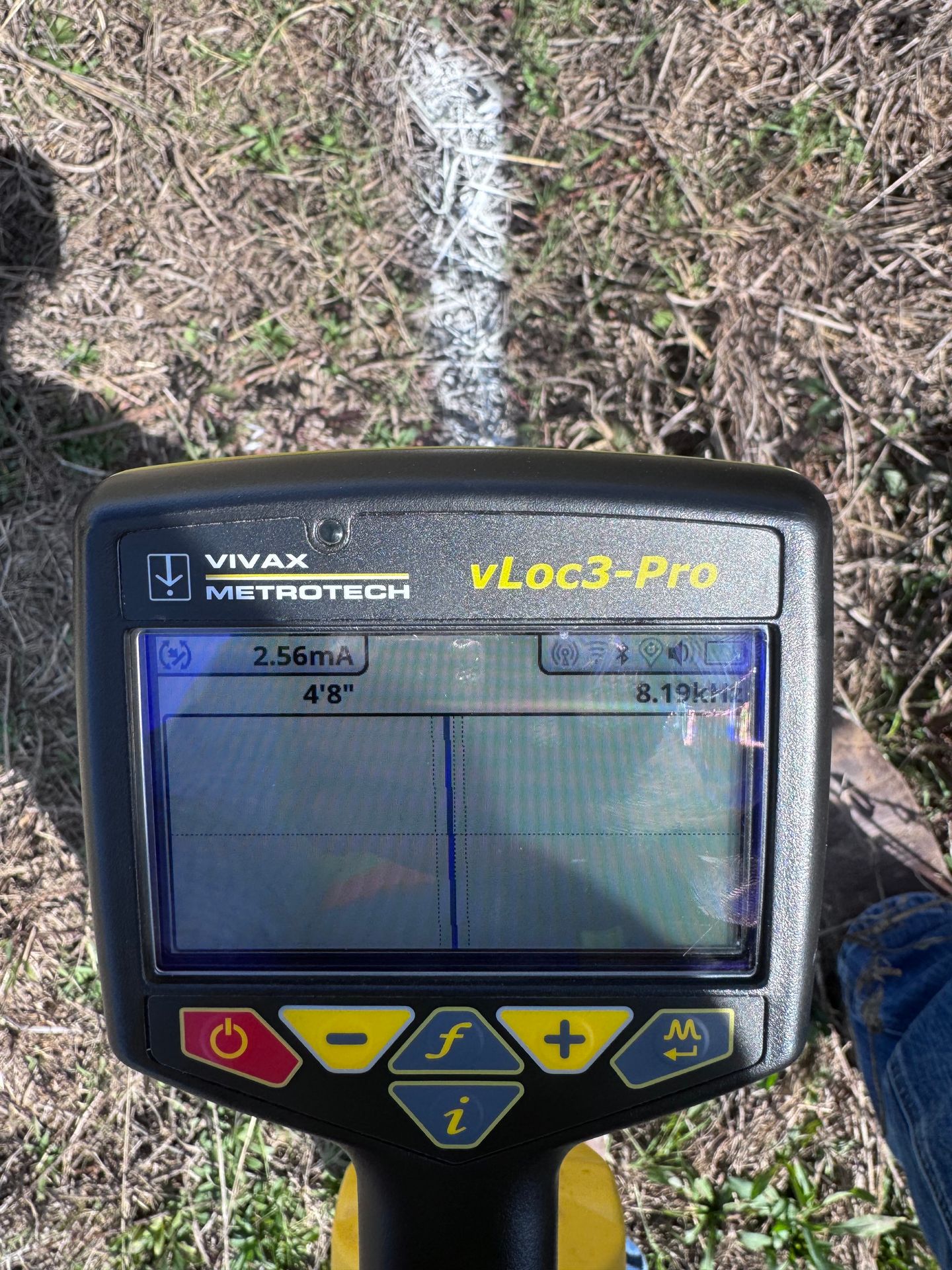
Locator depth is an estimate. A test hole is a measurement.
When a bore or trench needs real clearance, vacuum excavation exposes the line and a tape measures it.
Send the Address & ScopeDepth Questions, Answered
Can I just dig carefully to the typical depth?
How accurate is the depth reading on a locator?
What is the only reliable way to know depth?
Does Texas law set burial depths?
Why was a line found shallower than any rule allows?
How deep are sewer lines usually?
Need actual depths, not typical ones?
Send the site and where clearance matters. We will locate the lines and measure the ones that count.
Ready to replace estimates with measurements?
Send the address, the excavation plan, and the crossings that matter. We will scope locating plus test holes to match.