
How Deep Are Sewer Lines Buried?
There is no single required depth for a sewer line in Texas. The plumbing code controls the slope of the pipe, not how deep it sits, so a sewer lateral starts shallow at your foundation and keeps getting deeper all the way to the city main. Plumbing references commonly put residential laterals somewhere between about 18 inches and 6 feet below the surface, and the only way to know the depth at a specific spot is to measure it there.
Why sewer lines get deeper as they go
Your water line runs under pressure, so it can go uphill, downhill, or flat. A sewer line can't. It runs on gravity, which means it has to fall the whole way from the house to the main. Every foot of pipe drops a little, and those little drops add up.
Under the International Plumbing Code, the minimum slope depends on pipe size:
- 2 1/2 inches and smaller: 1/4 inch of fall per foot.
- 3 to 6 inches: 1/8 inch per foot. Most house sewers are 4 inch pipe, so this is the row that usually applies.
- 8 inches and larger: 1/16 inch per foot.
Run the math on a typical lot. An 80 foot lateral at 1/8 inch per foot drops 10 inches between the house and the main. At 1/4 inch per foot, it drops 20 inches. Plumbers often lay pipe steeper than the minimum, so the real number at the street can be well past both.
Texas doesn't use one plumbing code everywhere. The state plumbing board references both the International Plumbing Code and the Uniform Plumbing Code, and cities adopt one or the other, often with local amendments. If you need the exact rule for your property, your city's building or permitting office can tell you which code and which edition applies.
Where your sewer line is shallowest
The shallowest point is right where the pipe leaves the house. How deep that is depends on how the house was built. On a slab, the drain lines run under the slab and exit through or below the foundation, and the depth at that point was set when the plumbing was roughed in. Nothing in the code says it has to match your neighbor's.
The easiest way to find that starting depth is the cleanout. It's the capped 3 or 4 inch pipe sticking out of the ground near your foundation, usually on the side of the house that faces the street. Take the cap off and measure from the ground down to the bottom of the pipe. That number is your lateral's depth at that spot, and it only gets deeper from there.
If you can't find a cleanout, our guide to locating a sewer line on your property walks through where to look and what to do when there isn't one.
Where it's deepest: the connection to the main
The public main has to sit lower than every lateral that drains into it, so the deepest part of your sewer line is usually the last few feet before it ties in. Mains run under the street or in an easement, and their depth is set by the city's design for the whole neighborhood, not by your lot.
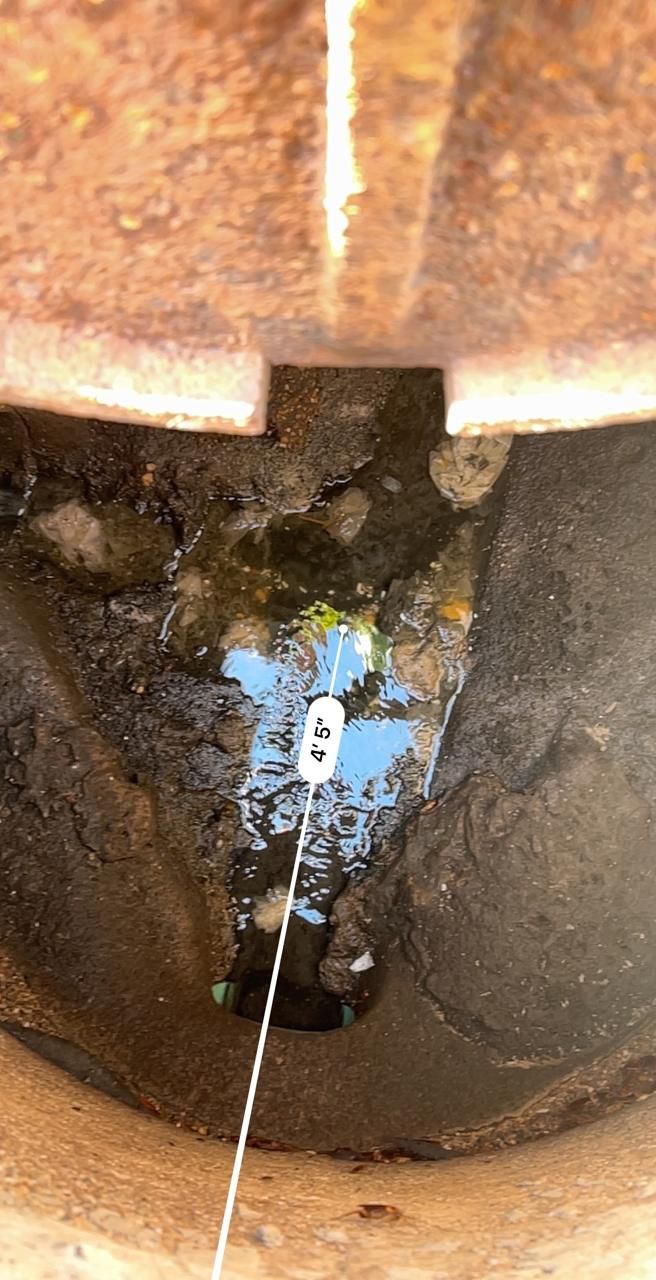
A manhole near your property gives you a rough idea. Measuring down to the flow line in the manhole tells you how deep the main is at that point. Your lateral connects somewhere above it. That is useful for planning. It is not a number to dig beside.
Why the real depth may not match the drawings
Even when a sewer line was installed to code, the depth you find today can be different.
- Grade changes. Landscaping, new driveways, pool decks, and fill dirt change the surface without moving the pipe. A line installed 3 feet deep can be 18 inches deep after a yard is cut down, or 5 feet deep after fill is added.
- Clay soil movement. Expansive clay across much of Texas swells when it's wet and shrinks when it dries. That movement shifts buried pipe and causes sags, offsets, and cracked joints, especially in older lines.
- Flat ground. Around Houston, flat terrain and a high water table mean many lines run with very little fall. A line with barely any slope stays close to the same depth for a long way, which surprises people expecting it to dive.
- Repairs and reroutes. A section replaced years ago may not follow the original path or depth, and old pipe is often left in the ground.
Septic systems are a different case
If your house drains to a septic tank instead of a city main, the building sewer runs to the tank, and the code handles depth differently. The International Plumbing Code sets a minimum depth below finished grade where the pipe connects to the septic tank, and it leaves the actual number to each jurisdiction. Check with your county or city before you dig near the tank. Our posts on finding your septic tank and finding the drain field cover the rest of the system.
811 won't mark your sewer lateral
When you call 811, the utility operators in the area mark the lines they own. The pipe from your house to the main is generally the property owner's line. Austin's city code, for example, defines a private lateral as the part of the sewer system on private property that connects a home or business to the city's system. Nobody is notified to mark it.
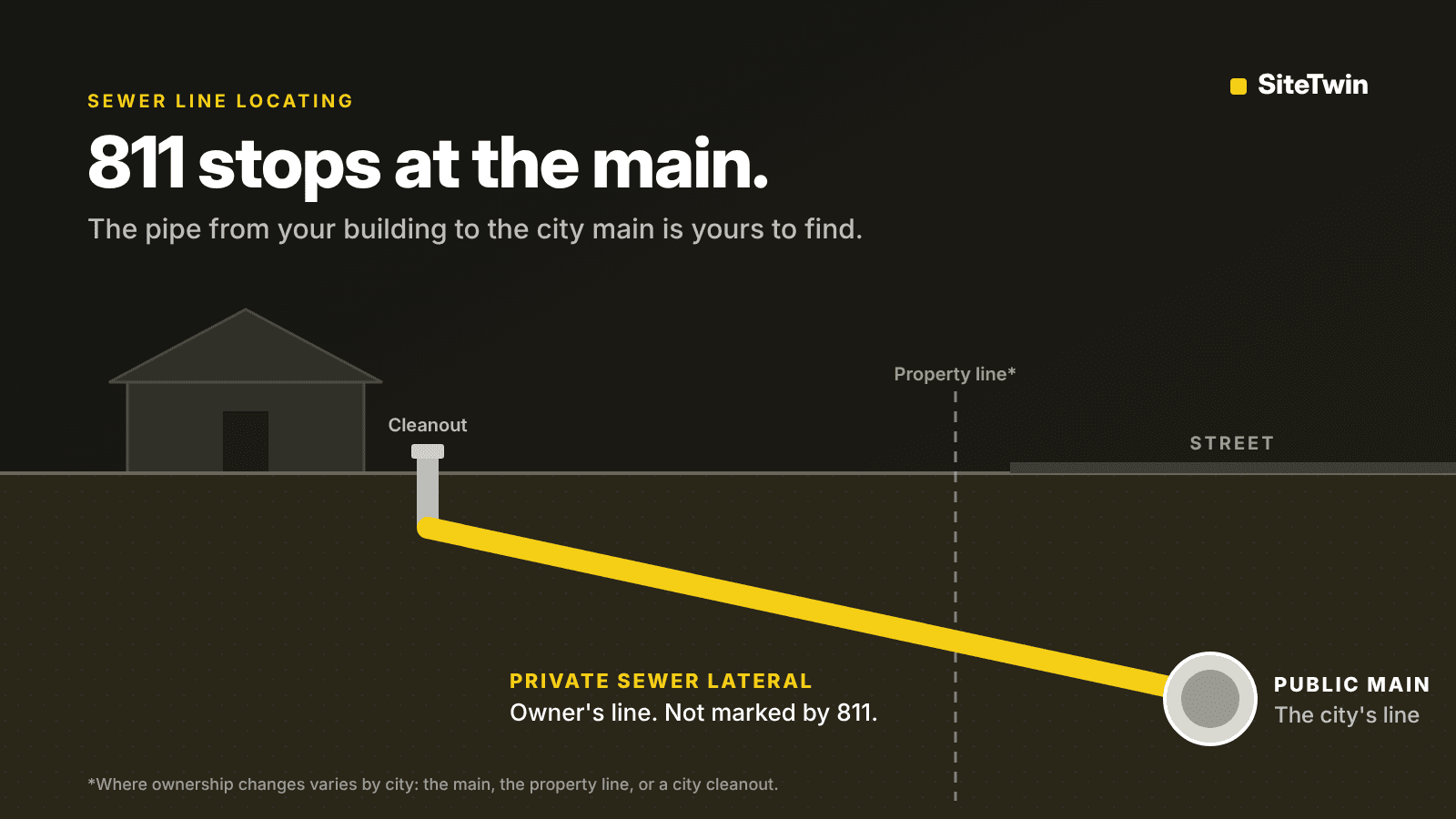
Where your ownership ends depends on the city. Some draw the line at the main, some at the property line, and some at a city cleanout. Our guide to 811 vs private utility locating explains what each one covers. When a sewer line is marked, the paint is green, the APWA color for sewer and drain lines. Our post on utility marking colors has the full list.
How to get an accurate depth
Most sewer laterals are PVC, clay, or cast iron, and almost none have a tracer wire. A standard electromagnetic locator has nothing to follow. These are the methods that work:
- Camera and sonde tracing. A camera goes into the line through a cleanout with a small transmitter near the head. A receiver above ground follows the signal, marks the path, and gives a depth reading at each mark. Our sewer camera inspection service records the inside of the pipe and maps the route on the same visit.
- Ground penetrating radar. When there's no way into the line, GPR scanning can pick up plastic and clay pipe. Wet clay limits how deep it reads, which we cover in our post on how deep GPR can see.
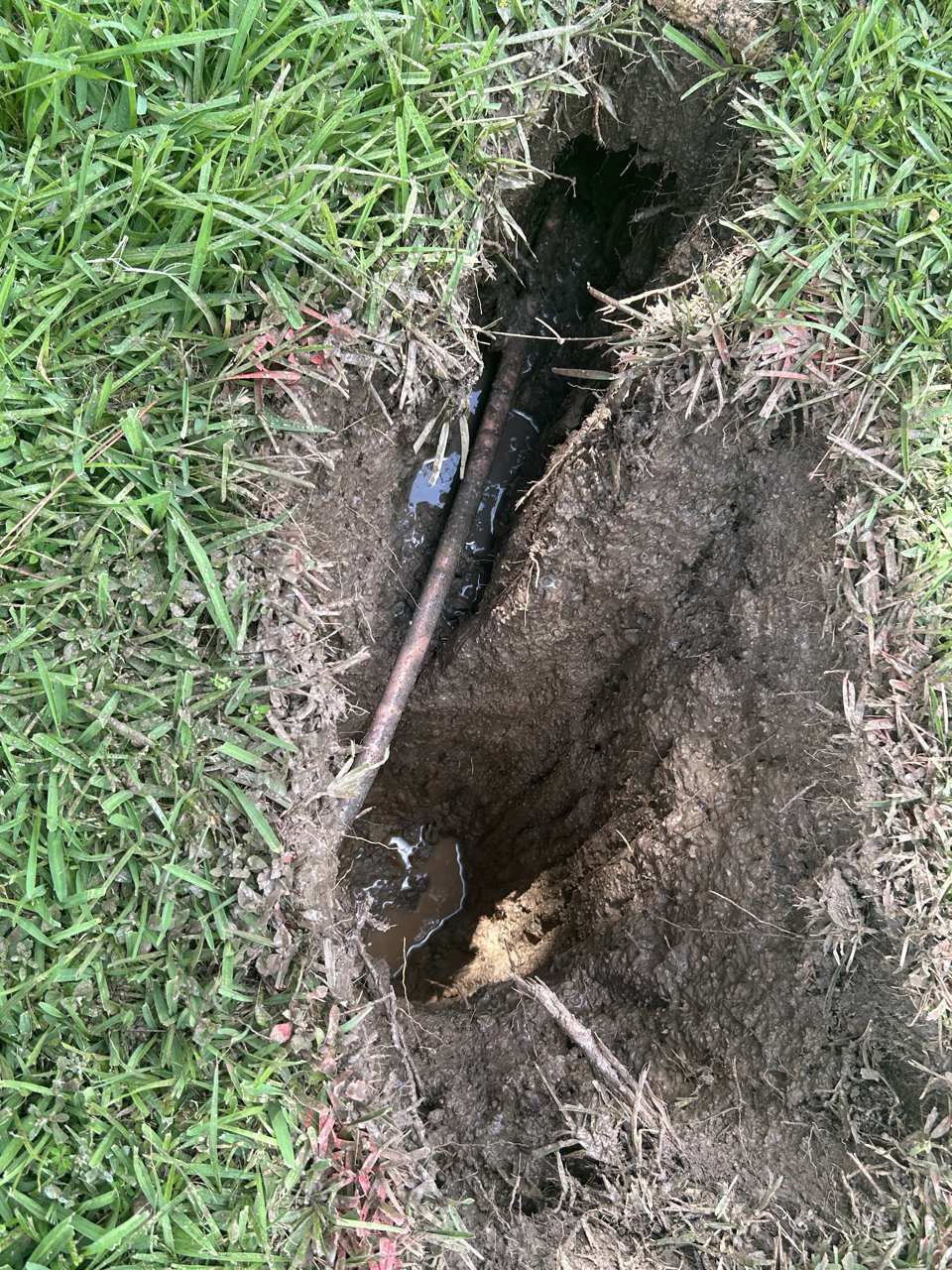
- Potholing. Every reading from a receiver or radar is an estimate. When you're boring across the line or digging close to it, vacuum excavation exposes the pipe so you can measure its actual depth.
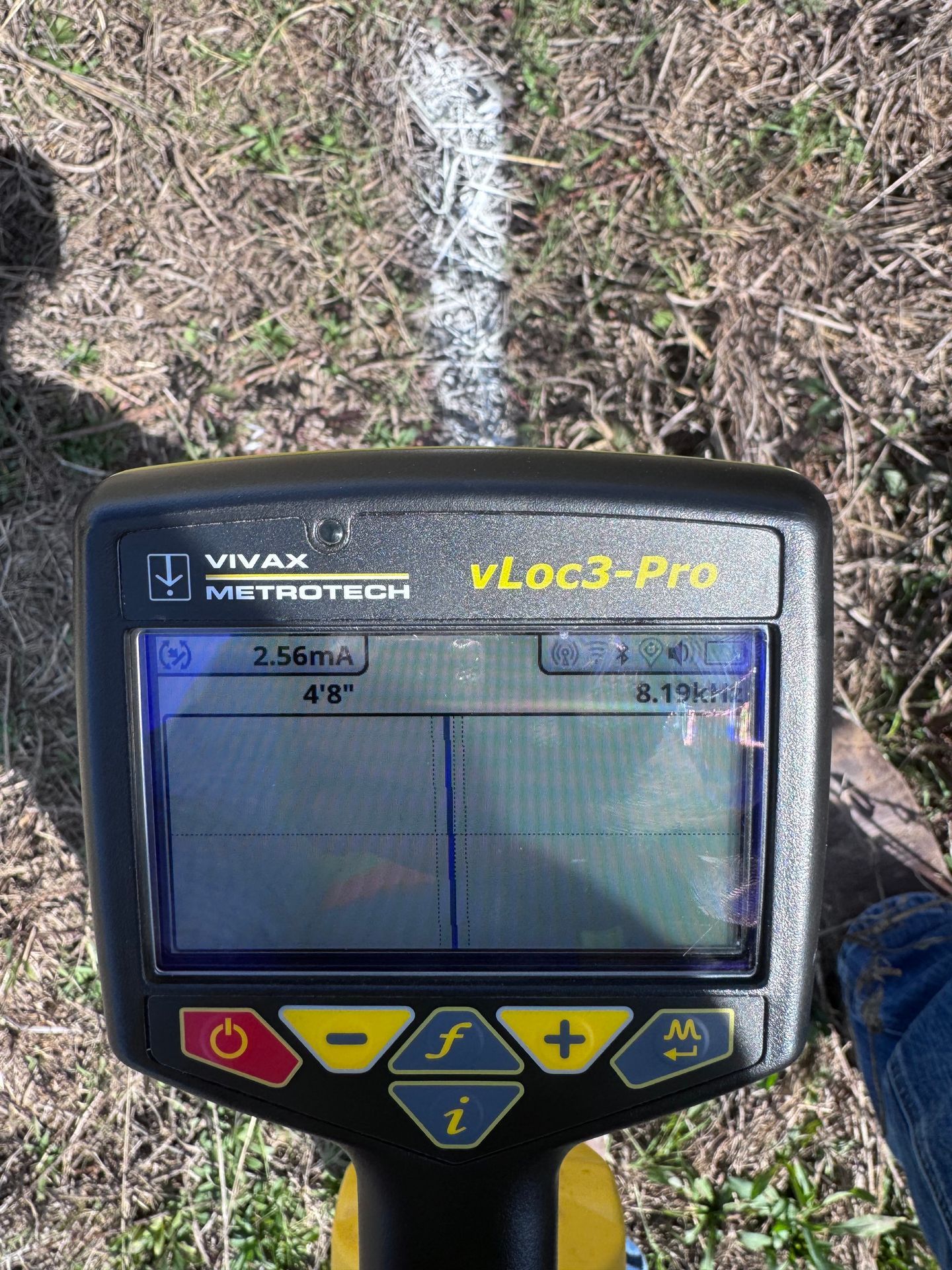
A good locate gives you depth readings at intervals along the run, not one number for the whole line. The line gets deeper as it goes, so a single reading near the house tells you very little about where it sits at the street.
The jobs that hit sewer lines
Sewer laterals get damaged by work that seems shallow enough to be safe: fence posts, tree planting, irrigation trenching, French drains, and pool excavation. Because the lateral is shallowest near the house, the riskiest digging is usually the work closest to the foundation. Pool builders run into this constantly, which is why we wrote a page on utility locating for pool and outdoor builders.
The other buried lines on a property follow different rules. See how deep water lines, gas lines, and electrical lines are buried, or start with our guide to utility depths in Texas.
Quick answers
How deep is a sewer line from the house?
It's shallowest where it leaves the foundation. Measure at the cleanout from the ground to the bottom of the pipe. From there it gets deeper the whole way to the main.
How deep are sewer lines buried in Texas?
No statewide depth applies. Texas cities adopt the International Plumbing Code or the Uniform Plumbing Code, and those set the slope of the pipe, not a fixed depth. Residential laterals commonly fall somewhere between about 18 inches and 6 feet deep.
How much does a sewer line drop per foot?
Under the International Plumbing Code, a 4 inch house sewer needs at least 1/8 inch of fall per foot. Smaller pipe needs 1/4 inch per foot.
Does 811 mark sewer lines?
811 marks the public main. The private lateral from your house to the main is generally the owner's line, so it isn't marked. A private utility locator can trace it.
Planning to dig, bore, or build near a sewer line? SiteTwin traces sewer laterals with camera, sonde, and GPR across Austin, Houston, Dallas, and San Antonio. Request a locate or call 512-610-8824.